
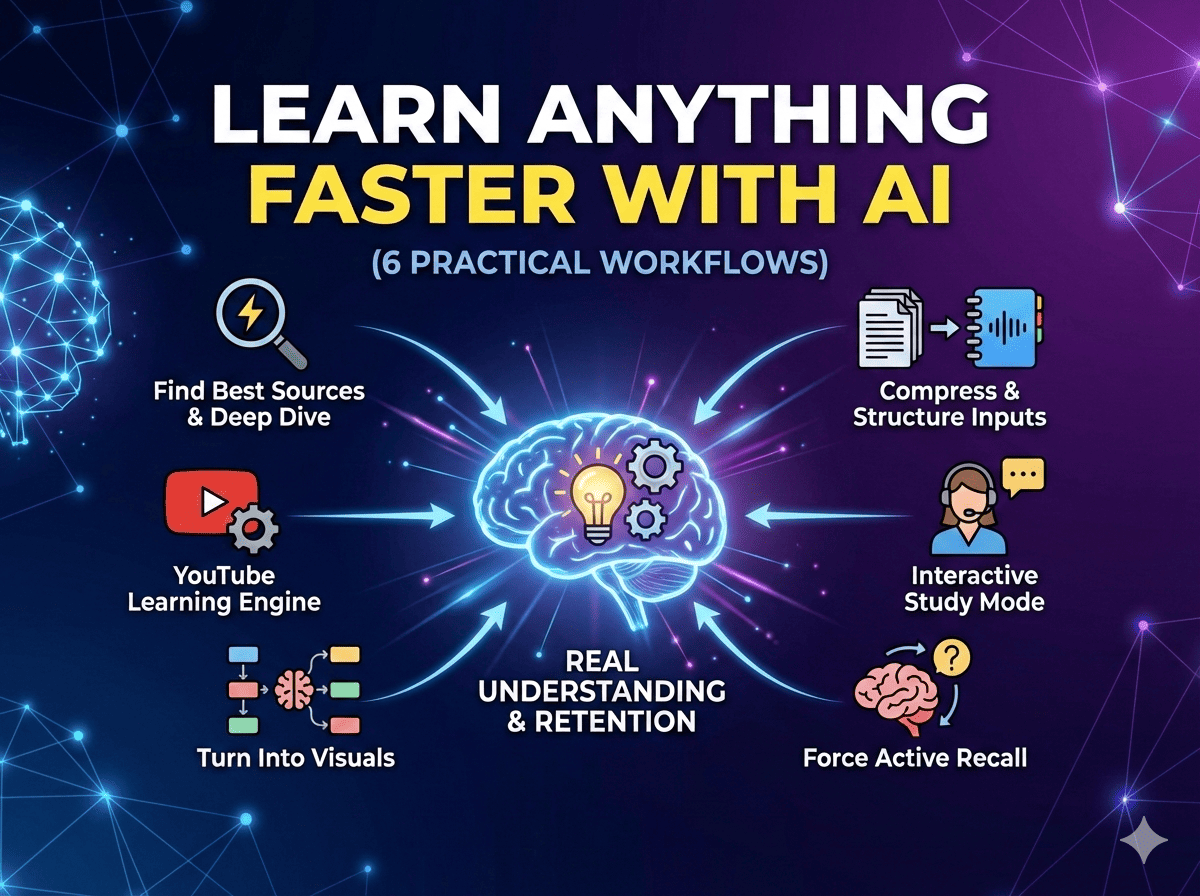
How to Use Artificial Intelligence to Learn Faster in 2026
Whether you're a student, a professional in career transition, or simply someone eager to grow — AI tools can transform the way you learn, memorize, and master new skills. Here's your complete, practical guide for 2026.
- Why AI Transforms Learning
- Key Benefits of AI for Learning
- Best AI Tools for Learning in 2026
- How to Learn a New Skill with AI
- How to Learn a Foreign Language with AI
- How to Succeed in Your Studies with AI
- Mistakes to Avoid
- Best Learning Methods Combined with AI
- The Future of Education with AI
- Conclusion & CTA
- FAQ
We live in the age of information overload. Between online courses, YouTube tutorials, podcasts, and textbooks, the real challenge in 2026 is no longer finding knowledge — it's absorbing it faster, retaining it longer, and applying it more effectively.
This is precisely where artificial intelligence becomes a game-changer. AI doesn't just give you answers — it becomes your personal tutor, your study partner, your coach, and your research assistant all in one. And the best part? Many of the most powerful tools are completely free.
In this guide, we'll show you exactly how to use AI for learning — from mastering a new skill from scratch, to acing your exams, to picking up a foreign language faster than ever before.
Why AI Transforms Learning
Instant Access to Information
Traditional learning often involves hours of searching through textbooks, academic papers, and search results to find a clear explanation. With AI tools like ChatGPT or Perplexity, you get a direct, tailored answer in seconds — freeing up your time to actually understand and practice rather than search.
Personalized Learning Paths
One of the biggest limitations of traditional education is its one-size-fits-all approach. AI breaks that mold. It adapts to your current level, your pace, and your learning style. Whether you're a visual learner, a hands-on practitioner, or someone who needs concepts explained three different ways — AI adjusts in real time.
24/7 Learning Assistance
Your AI tutor never sleeps. Whether it's 2am the night before an exam or a Sunday afternoon when you're stuck on a concept, your AI assistant is always available — without judgment, without impatience, and without a subscription to a tutoring service.
Reducing Research Time
Studies suggest learners spend up to 40% of their study time just searching for the right information. AI slashes that number dramatically, letting you spend far more time on actual comprehension, practice, and retention.
The Key Benefits of AI for Learning Faster
Saving Time
AI can summarize a 200-page textbook into a 2-page brief. It can explain a complex concept in plain language in under 60 seconds. What used to take hours now takes minutes — giving you more time to practice and apply what you've learned.
Better Understanding of Complex Concepts
Struggling with a difficult concept? Ask AI to explain it three different ways — with an analogy, with an example, and step by step. This multi-angle approach is one of the most powerful techniques in smart learning.
More Effective Revision
AI can generate flashcards, quiz questions, and practice tests from any content you provide. This transforms passive review into active recall — one of the most evidence-backed techniques for long-term memorization.
Personalized Learning
Unlike a standard course that moves at a fixed pace, AI adjusts to you. Struggling with a specific topic? AI drills deeper. Already mastered a concept? AI moves you forward faster. This is truly adaptive, intelligent learning.
Motivation and Progress Tracking
AI tools can help you set daily learning goals, track your progress, celebrate milestones, and identify gaps in your knowledge — keeping you motivated and moving forward consistently.
The Best AI Tools for Learning in 2026
ChatGPT remains the most widely used AI tool for digital education. Its conversational nature makes it feel like chatting with a brilliant, infinitely patient tutor.
- Simplified explanations: Ask it to explain any topic at any level — from beginner to expert.
- Course summaries: Paste a lecture transcript or chapter and get a concise, structured summary.
- Personalized exercises: "Create 10 practice problems on quadratic equations, progressively harder."
Claude by Anthropic excels at processing and analyzing long, complex documents. It's ideal for university students who need to work with dense academic papers, research reports, or lengthy textbooks.
- Deep document analysis: Upload a PDF and ask "What are the three most important arguments in this paper?"
- Detailed syntheses: Get structured summaries that preserve nuance and key details — not just surface-level bullet points.
Google's Gemini combines the power of AI with real-time web access and multimodal capabilities — meaning it can process text, images, and even audio to help you learn in multiple formats simultaneously.
- Ask questions about images, diagrams, or charts you're studying
- Get up-to-date information on fast-evolving topics (science, tech, current events)
- Use it inside Google Docs or Slides to enhance study notes
For learners who need reliable, fact-checked information with sources they can actually verify, Perplexity is the gold standard. It's a must-have for student productivity and academic research.
- Every answer comes with clickable, verifiable source links
- Perfect for research papers, fact-checking, and academic work
- Follow-up question feature for drilling deeper into any topic
NotebookLM by Google is arguably the most powerful tool for students. You upload your own course materials, textbooks, and notes — and it becomes an AI assistant that can only answer based on those sources. No hallucinations, no irrelevant information.
- Upload your lecture notes and ask "What are the 5 key concepts from this chapter?"
- Generate audio podcast summaries of your notes — perfect for reviewing on the go
- Create study guides, timelines, and glossaries automatically
- Quiz yourself based exclusively on your uploaded content
Other Useful AI Tools for Learning
How to Use AI to Learn a New Skill — Step by Step
Here is a proven, 5-step process for using AI tools to master any new skill, from coding to photography to public speaking.
Define a Clear, Specific Goal
Don't just say "I want to learn Python." Say "I want to build a basic data analysis script in Python within 30 days, starting from zero." A specific goal gives AI the context it needs to build you a realistic, focused plan.
Build a Personalized Learning Plan
Ask ChatGPT or Claude: "Create a 30-day learning plan for [skill]. I can dedicate 45 minutes per day. Include resources, milestones, and daily topics." You'll get a structured curriculum in seconds that would have taken hours to research manually.
Create Personalized Exercises
Generic exercises don't account for your specific gaps. With AI, you can say: "I'm struggling with loops in Python. Give me 5 progressively harder exercises with hints, then reveal the solutions." This precision accelerates progress dramatically.
Test Your Knowledge Actively
After each study session, ask AI to quiz you. "Quiz me on everything I just learned about [topic]. Ask 10 questions, one at a time, and wait for my answers before giving feedback." This active recall technique is proven to double retention rates.
Track Your Progress and Adapt
At the end of each week, reflect with AI: "Based on the topics I've covered this week, what are my likely weak areas? What should I review next week?" This metacognitive loop keeps your intelligent learning on track and continuously optimized.
How to Use AI to Learn a Foreign Language
Language learning is one of the areas where AI shines brightest. It combines conversation practice, instant error correction, and personalized vocabulary — things that used to require expensive classes or a native speaker friend.
Simulated Conversations
Ask ChatGPT to role-play as a native speaker: "Let's have a conversation in Spanish. I'm at B1 level. Correct my grammar mistakes after each of my messages, but let me finish speaking first." This is immersive practice on demand, at any hour.
Instant Error Correction
Write a paragraph in your target language and ask AI to identify every grammar, vocabulary, and style error — with explanations. This targeted feedback loop is far more effective than just reading grammar rules.
Personalized Vocabulary Building
Rather than memorizing random word lists, tell AI your context: "I'm learning business French for job interviews. Give me the 30 most important vocabulary words and phrases, with example sentences." Relevant vocabulary sticks far better.
Daily Practice Exercises
Ask for a new 10-minute daily challenge: translation exercises, fill-in-the-blanks, or short writing prompts. Consistent daily practice — even in short bursts — is the single most effective language-learning strategy.
How to Use AI to Succeed in Your Studies
For students, AI is the ultimate study companion — available 24/7, infinitely patient, and capable of adapting to any subject or level.
Exam Preparation
Upload your past exam papers to NotebookLM or share them with ChatGPT and ask: "Based on these past exams, what topics are most likely to appear? Create a targeted revision plan for the next 7 days."
Course Summaries
Paste lecture transcripts, chapter texts, or dense paragraphs and ask AI for a structured summary with the key points, definitions, and examples clearly separated. Turn 40 pages of notes into a 2-page revision sheet instantly.
Creating Revision Flashcards
Ask ChatGPT: "From this content, create 20 flashcard-style question-and-answer pairs, in the format: Q: [question] / A: [answer]." You can then paste these into Anki or any spaced-repetition app for maximum retention.
Automatic Quizzes
Use NotebookLM's built-in quiz feature or prompt AI directly: "Quiz me on [topic] with 15 multiple-choice questions. Show me one question at a time and give detailed feedback after each answer." This active testing is one of the most powerful tools for student productivity.
Mistakes to Avoid When Using AI for Learning
⚠️ Copying Without Understanding
The biggest trap. Pasting AI-generated answers directly into your work without truly understanding them defeats the entire purpose. AI should explain to you, not think for you. Always ask "why" and "how" — not just "what."
⚠️ Total Dependence on AI
AI is a tool, not a crutch. If you can't recall or apply a concept without AI assistance, you haven't learned it — you've just borrowed it temporarily. Regularly test yourself without any AI help to ensure genuine mastery.
⚠️ Neglecting Source Verification
AI models can generate confident-sounding but factually incorrect information — a phenomenon called "hallucinations." For academic work, always cross-reference AI-generated facts with authoritative sources like textbooks, journals, or Perplexity's cited results.
⚠️ Ignoring Real-World Practice
No amount of AI-assisted study can replace hands-on practice. Learning to code? Write real projects. Learning a language? Have real conversations. AI accelerates the learning curve, but genuine skill only comes from doing.
The Best Learning Methods Combined with AI
AI doesn't replace proven learning science — it supercharges it. Here are four evidence-backed techniques that become dramatically more powerful when combined with AI.
🔁 Spaced Repetition
Review material at increasing intervals to maximize long-term retention. Use AI to generate flashcard sets, then run them through an app like Anki. Ask AI to identify which concepts you should review first based on difficulty.
🧠 The Feynman Technique
Explain a concept in simple language to identify gaps. AI is a perfect partner for this: explain a concept to ChatGPT as if it's a 10-year-old, and ask it to point out any gaps, errors, or oversimplifications in your explanation.
✍️ Active Learning
Passive reading retains roughly 10% of information. Active engagement — writing, teaching, debating — retains up to 90%. Use AI to simulate debates, pose challenging questions, and push back on your reasoning to keep your brain actively engaged.
📝 Smart Note-Taking
After taking raw notes, paste them into AI and ask for a structured, hierarchical version. Then ask: "What are the 3 most important takeaways? What questions should I be able to answer after studying this?" This transforms passive notes into active learning tools.
The Future of Education with Artificial Intelligence
We are only at the beginning of AI's impact on digital education. The coming years will bring transformations that will make today's tools look primitive by comparison.
🤖 Personalized AI Tutors
Dedicated AI tutors that know your full learning history, your strengths and weaknesses, and adapt every session in real time — delivering a truly individualized education at zero cost.
📚 Continuous Learning
AI will make lifelong learning seamless — helping professionals upskill in hours rather than months, bridging the gap between career demands and available training.
🎯 Adaptive Learning Systems
AI-powered platforms will assess learners in real time and dynamically adjust content difficulty, format, and pacing — making every minute of study time maximally effective.
🌍 Education for Everyone
AI is democratizing access to world-class education. A student in a remote village with a smartphone and an internet connection will have access to the same quality of learning as someone attending a top university.
The Smartest Learners Use Every Tool Available
Artificial intelligence doesn't make learning effortless — but it makes it dramatically faster, more personalized, and more effective. Whether you use ChatGPT to explain a concept, NotebookLM to study your own notes, or Perplexity to verify your research, every tool in this guide is available to you today, for free.
The learners who will thrive in the coming years aren't the ones who work the hardest — they're the ones who work the smartest. And in 2026, working smart means embracing AI as your most powerful learning ally.
Start with one tool today →SEO Elements
5 Alternative SEO Titles
- Learn Faster With AI: The Complete Guide for Students and Professionals in 2026
- Top AI Tools for Learning in 2026: Study Smarter, Not Harder
- How to Use ChatGPT, Claude and NotebookLM to Master Any Skill in 2026
- AI for Students: How to Use Artificial Intelligence to Ace Your Studies in 2026
- The Ultimate Guide to AI-Powered Learning: Memorize More, Study Less in 2026
FAQ — Frequently Asked Questions
1. Can AI really help me learn faster, or is it just hype?
It's not hype — but it depends on how you use it. AI doesn't magically transfer knowledge into your brain. What it does is dramatically reduce the time you spend searching for information, help you get clear explanations instantly, and enable highly personalized practice. Used correctly, students and professionals consistently report cutting their study time by 30–50% while improving their results.
2. Which AI tool is best for a student starting from scratch?
NotebookLM is arguably the most powerful tool for students because it works exclusively with your own course materials — eliminating misinformation. Pair it with ChatGPT for explanations and Perplexity for research, and you have a complete learning system that covers every aspect of studying.
3. Is using AI for studying considered cheating?
Using AI to understand concepts, generate practice questions, and improve your comprehension is not cheating — it's leveraging available tools, just as calculators or search engines were once controversial but are now standard. What matters is that you genuinely understand and can apply what you've learned. Submitting AI-generated work as your own without understanding it, however, is academic dishonesty.
4. How much time per day should I use AI for learning?
There's no strict rule, but a healthy approach is to use AI as a tool within your study sessions rather than replacing them. A typical effective session might be: 10 minutes with AI to plan your study session and clarify key concepts, 30–40 minutes of focused practice and study, then 5–10 minutes with AI for self-testing and review. The goal is active engagement, not passive consumption.
5. Can AI help me learn a language from absolute zero?
Yes, and it's remarkably effective. AI can introduce you to a new language systematically — starting with the most common words and phrases, gradually building grammar, and providing instant conversational practice from day one. Combining AI conversation practice with spaced repetition flashcards is currently one of the most effective free methods for language acquisition available.
